Friday, September 15, 2023

You’re OK - I’m OK

 "I am a person. You are a person. Without you I am not a person, for only through you is language made possible and only through language is thought made possible, and only through thought is humanness made possible. You have made me important. Therefore, I am important and you are important. If I devalue you, I devalue myself. This is the rationale of the position I'M OK - YOU'RE OK."

- Thomas A. Harris, I'm Ok, You're Ok: A practical guide to Transactional Analysis

Thursday, August 17, 2023

What is good art worth?

What is good art worth?

Art is a precious commodity, like oil or gold. It has its own value, whether it be on sale in a gallery, magazine, or comic book. Its price is raised when it goes appreciated, and lowers its price when it is depreciated. Investing in art is like investing in the stock market. If you pick an artist or stock that becomes highly successful, you get the difference in profit. If you pick an artist or stock that depreciates quite a bit, and falls in market value, you pay the difference in losses.

But art is more than money. It is worth more than gold or oil, but that is most the point I’m trying to make when I say it is worth more than money. I mean worth more than money can pay for. Even if you pay top price for an art piece, you’ve acquired something more valuable than that price, in the work of art itself.  That type of value is called artistic value, and using that term means more things than simply monetary value, although that is an included attribute of artistic value. 

There is value to art in attributive goodness, or goodness or badness of an artwork being an artwork, in the nature or semblance of its being an artwork.

Philosophically, there are moral, political, and aesthetic dimensions, also. But I’m interested in the attributive goodness for my purposes.

Artistic goodness is something that different can appreciate in different amounts, in different ways, and in different settings, or times and places. Different cultures also appreciate this goodness in various ways differently to each other, as well as individuals also varying in all these ways and more. It is arguable that the amount of sunlight a work of art receives will vary the way the same person values its goodness even on the same day, in the same hour.

So because these variances exist, not only in the ways people perceive and evaluate art, but also in the meanings given to art by the artist, and by the spectators who view it, there is no way to measure this quantity of appreciative goodness. It’s left open to suggestion, of course. Most critics discuss what makes that artwork good or bad, and most people would incline their views of artwork in a similar fashion if they sat down to write about it. But it seems that even criticisms fall short of being the goodness of the criticism of the art. There almost always almost certainly needs to exist the artwork for the criticism to remain valid for long. So the goodness of art is rather an existential quality, a sort of preoccupation with our existence and its meaning. It could even be argued that there is religious meaning to specific cultures and people in those cultures regarding at least some pictures. I think it goes without saying that we all are known to participate in the process of culture, and it is hard not to contaminate one’s dealings with the processes of beauty, regardless of whether one considers something art, one still probably regards something as beautiful, or at least not ugly.

If existence is beautiful, and it is not merely a category of living, or of dying, then we are approaching the transcendent and ineffable when we discuss art. It cannot yet be called the meaning of life. So we stop short of that, in favor of something else. In favor of some type of moment in time, a moment in which something emerges in our existence due to it being part of our artistic reveries, or perhaps someone’s recorded journey of artistry in a work of art, that is similar to the feelings one has on a spring day, perhaps. Or perhaps what one remembers feeling when in love. Or what one knows about the universe from seeing it up close and personal on a night trip under a cloudless sky in a remote location. We have an opinion about what constitutes art’s value in attributive goodness, based on those types of feelings. It is those subjective impressions that provides art’s meaning and purpose in our lives. 

It forms a part of our consciousness that represents the best of our imagination, the best of our emotions, and ideas. It conjures for us all that we hope and aspire to be or to have become in living and in dying, and it exalts us to that level, by affirming our desires to be synonymous with those aspirations that are more spiritual and existential than they are tangible. It makes us feel one with the universe, or God, or the universe beyond our present conception. And in this way, it provides not the meaning of life, but maybe something to take with us wherever life’s journeys lead us. Beyond imitation in the goodness of the human spirit, art takes away all and gives even more back. Art, the immaculate odyssey home to where life came from and is going to return to, is one of the central preoccupations of humankind. And the goodness attributable to that, is hard to put into monetary terms. It just isn’t a fair trade. 

Why is art “the right thing?”

 Why is art “the right thing?”


Why is art something so right most of the time that it can thwart evils such as hatred, greed, prejudice, and destruction? 


There might be something intrinsically moral or legally praiseworthy about such a powerful force for good.


What makes art so ethical? It is an ethos of confrontation with the shadows of our society, calling them out into the light.


Art is revelatory, visionary, and it casts creative light into the dark places that those with dark hearts do hope that light would never be seen.


But we need to see it, in every instance, and in every detail, lest we tread in places where shadows eat at our dreams, and won’t be stopped until we let that revelatory light in to stop it.


Art is itself a light that prevails over that which would obscure truth, goodness, and beauty, and what are the finest parts of our humanity, which we come to know through the appreciation of art.


Art has a shadow, and that is fear, frustration, worry, doubt, anxiety, and complexes in some cases.


But those who choose to create art work, do so knowing that they are paying but a small price to speak and show us their views.


And it is a negligible risk for our society, which would generate for itself far worse problems in art’s absence.


Saturday, April 8, 2023

The Nazis had a hangup about comics, and my well-considered response.

I have a peculiar problem. I like to talk about things that other people don't. And I want to create a comic book about the 1930's and 1940's. And in doing research it occurred to me, that I want to create comics that take the objections that have been made about them into account. 

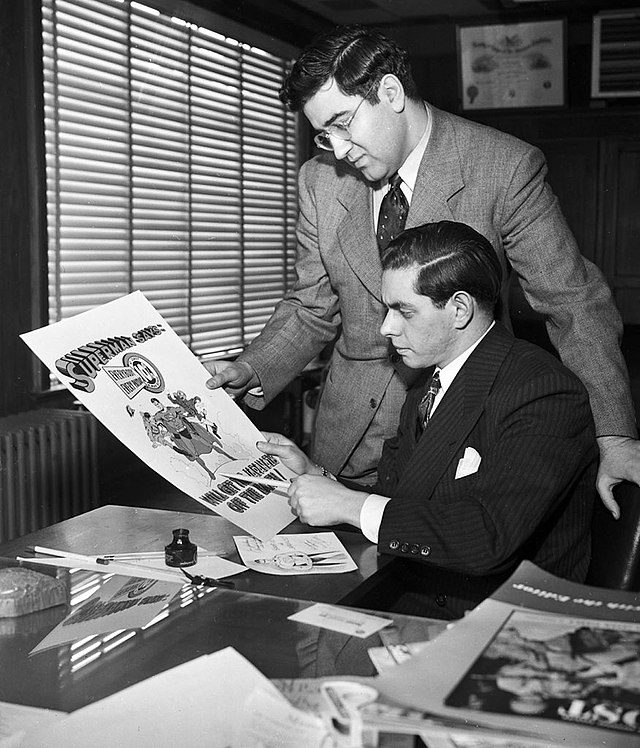
Some far-right extremists say comics are part of a Jewish media conspiracy. Perhaps I could make a comic that takes this into account. How do I take that into account? First I need to visualize the problem. So I look at a picture of Jewish people creating Superman. 

I see what the far right in Germany thought about this photo. Joe Schuster is pointing his pen at Superman. He is selling out the Nazi ideal image, forming a media presence, and helping form a positive impression about Jewish people worldwide.

The Nazis become angrier about Joe Schuster making money from his pet project, than about the comic itself. They are upset that he is storing gold in the basement of a house in America, where Hitler will be kept out of the reading room, and Jewish children will live in union with God.  This was very upsetting to militant Nazis in Germany, apparently, if history is to be trusted.

All this because the Jewish genetic makeup is, according to unscientific diagrams, supposedly of deformity and mental illness and disease. And Superman proves this somehow, too well, to the Nazi mindset about comics and degenerate art and their ideal of freedom from Jews.

How does Superman prove Jewish mental illness to the Nazis? Somehow Superman stands for the Nazi freedom ideal in reverse of itself. It is the inverse image of the Superman that the German Nazis believed in, which was promulgated by their propaganda about Friedrich Nietzsche. 

The Nazis are battling themselves on many fronts. They are battling the inevitability of progress in any genetic makeup of those with mental illnesses, and they are battling the progress of the Jewish people. They are battling the entire Jewish extermination program also, because this program exceeds the boundaries of extremism, by quite a large degree. It is counter productive to kill the enemy based on ideals of fitness, because there is no absolute standard for human perfection. 

Humans are all imperfect. We all might as well have mental illnesses, and be Jewish. It doesn't matter. Perfection is not the point. Genetic goals are not the point. The ideal is fulfillment of our genetic makeup, in the mode of living, not the extermination of others who don't stack up to the genetic ideal of the moment. 

Jerry Siegel and Joe Schuster were living that ideal, of personal fulfillment, and community activism and involvement. They were fulfilling their innate human potential, and the Nazis were trying to proclaim themselves the Superman. All this while two Jewish men made comics about it. In the end I suppose it makes all the difference in the world that these two added something more to our understanding of others in the world, rather than detract from it. Giving back instead of taking away human dignity and freedom, not to mention human lives, was a setback for Germany and the world.

Let's move forward and learn from these mistakes, never forgetting these lessons, because our children and our future generations will need to understand.

Wednesday, March 1, 2023

Ready for Work on Comics

I'm old and have no hair, which is all the better reason to get going and really work on my best work, in my twilight years. Age is my asset, as I have tons of experience and style. My body type is not the real reason for assuming I'm not fit for work, is it? Body type does not disqualify people from work opportunities, if the person is physically and mentally capable, which I am according to my doctor. Cease and desist your apathy, and do some more work on what you feel you want to. Work is not a crime at any age.

  1. Ableism (also, The Con Artist's Fallacy; The Dacoit's Fallacy; Shearing the Sheeple; Profiteering; "Vulture Capitalism," "Wealth is disease, and I am the cure."): A corrupt argument from ethos, arguing that because someone is intellectually slower, physically or emotionally less capable, less ambitious, less aggressive, older or less healthy (or simply more trusting or less lucky) than others, s/he "naturally" deserves less in life and may be freely victimized by those who are luckier, quicker, younger, stronger, healthier, greedier, more powerful, less moral or more gifted (or who simply have more immediate felt need for money, often involving some form of addiction). This fallacy is a "softer" argumentum ad baculum. When challenged, those who practice this fallacy seem to most often shrug their shoulders and mumble "Life is ruff and you gotta be tuff [sic]," "You gotta do what you gotta do to get ahead in this world," "It's no skin off my nose," "That's free enterprise," "That's the way life is!" or similar.

Tuesday, February 14, 2023

The targeting of enemies - minorities, liberals, secularists, lefttists, urban naxals, intellectuals, assorted protestors - is not driven by a calculus of ordinary politics...

When you legitimize yourself entirely by inventing enemies the truth ceases to matter, normal restraints of civilization and decency cease to matter, the checks and balances of normal politics cease to matter.

- Pratab Bhanu Mehta, "JNU violence reflects an apocalyptical politics driven by a constant need to find new enemies.", The Indian Express, January 7, 2020.

I got this quote from Jason Stanley's book How Fascism Works, the Politics of Us and Them.

Monday, January 9, 2023

The Abstracted Other - Projected Inner Speech

The Abstracted Other - Projected Inner Speech


There is commonly understood to be but one secondary process, one which involves the conscious mind. However, there are those who have a more complicated secondary process, one influenced and projected upon and by from the preconscious mind.


When there is breakdown in the brain between what is normally reserved for dreams or intuition, and what is normally just thoughts and feelings, there is a phenomena popularly known as hearing voices. Auditory hallucinations, that are represented by inner speech. 


It is like having a second primary process aspect, that mimics the speech of everyday life, but instead of being able to have body language cues governing the customs of speech, there are instead somewhat disembodied voices speaking to one another, to the person who hears them.


That this occurs is a known fact. There are many hypotheses about what causes it, most notably changes in the brain that increase as one ages. It is agreed that it is a symptom of schizophrenia, and that most, if not all, schizophrenics experience this at some time or other.


What is not understood is the internal representation of this, and why it can occur in a psychological sense, not just a physiological sense.  No one who has experienced this phenomena has to my knowledge written about it in a coherent notion of psychological cause and effect.


Why put a brain aberration in terms psychological, and not just accept that this occurs during the course of the disorder?


I think it comes down to telling the public what is going on in a believable sense, giving hope to those who might benefit from the insight of some writer who has experienced what they experience, and goes through the same sets of doubts and misunderstandings. Someone who sets the record aright about the large quantity of thoughts given to one and the thoughts these generate in response to the overwhelming need to understand the reason why these occur.


So I will generate a theory based on my experience as a person with schizophrenia and bipolar disorder, and attempt to explain the psychodynamics that I attach to such experience. It is at least a start to put into words my thoughts and feelings, and hope that this message reaches others with hope and respect for what they have experienced. It might be helpful to compare notes with researchers, and in general express my thoughts that I have not been able to share with my therapist, through the rigors of talk therapy, due to my own difficulty in explanation without notes, and the time limit imposed by a therapy session.


My theory is that inner speech is projected inner speech, that is, it is projected onto a projection screen in the manner a movie projector would project the sound from the film soundtrack, but not always with the images intact. I believe that there is a reason for this behavior of the brain. It is under stress from the environment, which causes it to hallucinate these projected inner speech acts, according to the needs and understanding of the unconscious mind. But in my understanding of the unconscious mind, we are all like trees, whose uppermost branches are the only ones which represent thoughts and somewhat lower the branches which express abstract feelings, and lower still concrete subjects of thought and emotion. There the conscious mind ends, and the trunk, the preconscious, leads down into the depths of the roots, which are only normally available to cognitive access during R.E.M. sleep or what is known as a dream. 


Furthermore, I think we are like trees in that our branches sometimes mingle, and this represents speech and body language. At the roots, however, the roots can’t use body language, but they sometimes mingle with the soil and the other trees’ roots. This represents dreams, and our unconscious cognitive set of data that impacts the other trees’ dreams. The roots are the projectors of inner speech, but through the trunk, the preconscious filter. The filter alters the projections according to what the unconscious and conscious circumstances tell it to. It acts as a two way bridge, while conscious, and unconscious both, for signals coming from other trees’ roots. It is like tickling someone’s foot and causing them to laugh, in that a vocalization issues from a stimulus that incites an impulse to vocalize.


The brain has developed altered pathways through the regard of these stimuli from the roots of the environment, and has been given impulses that the conscious mind interprets as speech. It is disconnected, very surreal speech, that is very much like a film of a soundtrack from a dream, except that the faces can not be clearly seen, nor the environment often perceived in any great detail. So one is left wondering what this means, because listening to a film without visuals does tell a story, but only if you can actively imagine it, instead of view it. And often the imagination is not fit for this task, so the meaning is obscured. If one knows how to interpret speech well, one might guess. But such takes practice, and knowledge of what body language corresponds to speech, instead of the usual order of what speech corresponds to body language, and may be difficult, and sometimes impossible to determine what each vocalized utterance might signify.


Dream interpretation and knowledge of psychology does stabilize the perception of these projections of inner speech that occur during the day instead of at night, while one is dreaming, and viewing the characters in the dream interact. I contend that if the narrative were a dream, and one could always see all of the drama involved in the hearing of the voices, it would make sense. It is like having a waking dream, that sometimes repeats, and sometimes makes sense, and at other times, requires an excellent dream interpreter to make sense of.


Patients often don’t realize this, though, and they are left believing they are telepathic, which as an impression is almost totally accurate as to what it seems to be. However, almost always, and this should be pointed out to patients, the messages of the projected voices are almost always known in the unconscious before they are heard spoken by the voice. And the voices respond to what the mind interprets them, in a fluid and sometimes shifting, and sometimes persistent way.


It is like the experience I had once hearing a squirrel appear to speak into my mind. It said something that I instinctively and unconsciously already knew, but was consciously not fully aware of, when it was spoken. The squirrel was telling me that women don’t understand what marriage is. However, it is a fact that squirrels don’t know what marriage is either. So I was interpreting something that came from within my mind, somewhere. Or else this would not manifest directly in my mind. Or rather, my brain somewhere is sending signals that my mind interprets as coherent speech, of a kind only possibly known in my unconscious mind, or dreams.


That voices of this kind can be bidirectional would be misstating the case. But they are bidirectional as projections, because they are based on a projection screen, in this case the squirrel. And what I expect to hear, based on what my unconscious needs me to know, is what will be projected as the squirrel talking in my mind as a projected inner speech act.


People also sometimes serve as projection screens for projected inner speech. Sometimes I will be looking at someone with curiosity, and will hear the person’s voice in my mind, telling me something that upon looking at the environment, seems totally appropriate. But if the situation changes, and upon talking to that person, I learn something that counteracts that intuition, and grounds it in further knowledge, any voice heard in that person’s voice will adopt the more real character instead.


I believe that this is because the unconscious mind adapts to new stimuli from recording the environment, and the verbal gestures of other people and myself. So if some prevailing intuition proves incorrect, the projection screen will sound back more intelligently and more accurately to what I can verify with my senses.


For this reason, I think schizophrenics need to watch lots of television and movies, and read lots of books, if not write books and movies and plays and things that piece together more materials to draw inferences from. This reveals the source of the voices to be internal, because one is aware more so that what one writes, reads, and views, changes the intercourse of the voices’ possible repertoire. There is a real psychophysical causation between the schizophrenic and the world, that should be representational, so as to facilitate reality testing in therapy.


Voices very often, almost always, have the character and seeming intentionality of thoughts, in my long experience. Almost never, past my initial year of having one occasional command voice, do the voice sound like real voices, that my ears can seem to hear. They always have an internalized, in-the-mind-only quality to them. Now it is like standing in the middle of a room of people that I can only hear and not see. It feels that these voices are invasive, and unwelcome. I receive lots of projected inner speech that is threatening and abusive. All in all, I have to say this is all because of the need for representation. These voices just want to be heard by me, from me, and they want to be represented. It is case probably of a repressed set of creative selves who wish to come out and play creatively with me, or just to be characters that I write about.


In fact, writing about my inner characters that speak to me in projected inner speech, often points out misunderstandings between me and other people from my past, who no longer interact with me. If I hear their voice, I tell them what I wrote about, and this alters that voice, not only within my mind, but within my dreams, as well. If I merely spoke that to the voice, and hadn’t written about it, it would lack a sort of cognitive force to it. It would be like merely speaking, and not creatively including the other voice into the personal contact with my creative self.


It is sort of like having a fragmentary creative self, that got fractured by some trauma, and became diffused throughout my brain. Putting these pieces back together again requires a creative willingness to write and draw things out on my part. It is inspiration for lots of creativity, but often also impedes progress because of the inconvenience of having my routine disturbed. But owning that my routine includes voices of the abstracted self does lead to wholeness. Setting aside time to write down what the voices have told me every day helps me cope, and alters the voices according to real input. I don’t believe that this activity further fragments my creative self. It tends towards wholeness and integration. It really all hinges on talking or writing about the issues at stake with each projected speech act. 


It helps to regard these projected speech acts as not just disembodied voices. It helps to feel for them like they are long lost relatives of oneself. Voices are a real class in empathy and development of the tripartite mind, though in a notoriously chaotic way. It seems that the fragmented self in my case is mostly id related, that is to say a trauma caused a repression of the id, which then wanted back into my wholeness by the only route available to it, given that my dreams might have spillover, or blocked content, possibly also repressed as a part of the id. In fact, I can conceive of the different characters in these voice projections might actually all be fragments of a repression of the part of the id that is blocked from unconscious contact with itself. Almost as though they are banished from dreams by a repressive force blocking my dreams. Their only avenue toward being heard is to escape the unconscious fragmented state by speaking to my conscious mind, which, upon hearing them out, and recording what they say, can reintegrate these alternate selves with itself.

Sunday, January 1, 2023

In the case of dreams and freedom of the press, friendship over enmity

 There are rivals to my work, some of whom consider me an enemy, or so it would appear by the type of things I dream about at night, the type of nightmares I endure. That is, if dreams are any indication of potential conflicts in life, whether I doubt this or not.

I am the pawn of justice. What am I doing here now? Taking what is given? Or giving others their due? I choose to take what is given, on the condition that I return it in equal measure. This publishing I see online is welcome, so long as mine is also.

Importunity of the press is a welcome opportunity to distinguish myself as a writer and an artist.

As a measure of truth and justice, and to measure out my goodness to the press, I take part in this mandate of security, to bolster writing and art, into the force that can compete with the level of writing that has gone into making me the subject of controversy.

Two enemies, taking to propaganda to out-write the other must end. It must be replaced by freedom of the press. As I seek this freedom, I might need to recast my attention on the other posters about my writing and art. I need to see this as a welcome challenge, a fruitful rivalry, a basic interest in the same things, being akin to friendship, not enmity.

Friendship might be a determinant of success in the press. To the extent that one recognize the competitors as friends and equals, one is allowed to post his or her own work to favorable audiences. Singling out the other to create an inequality, and rivalry that is not friendly, would be most disadvantageous to one's own reputation as a writer and artist.

Anyone would notice this discrepancy, and target the person who is least friendly and egalitarian as the target for hate, and not for listening to, reading and viewing the works published; because they are playing on an uneven playing field.