Sunday, October 13, 2024

Why I was unable to find the meaning of life.

I wrote a web article on the meaning of life, and in that article, I showed how several areas of research could prove promising in my quest to find the meaning of life. I showed how various philosophies, religious beliefs, and science facts showed that there could be a meaning to life.


What happened next was that I obtained what to me was the meaning of life. I called it gnosis, and I believed that I had discovered the answer to the questions philosophers had been asking for centuries and millennia.


What I did not realize is the immense hurdle this would present to myself and the understanding of others.


The first thing I realized is that I had found a truth that was in itself a foundation for a religious system, that of the gnostic Christians.


I could not believe that Gnosticism was entirely true, because the knowledge of God, or gnosis, depended on a belief or a faith in such knowledge to exist. So it was just Christianity by another disguise, one that no modern Christian would uphold, making this a very unpopular view to uphold at a church.


I realized then that if someone had found the real and true meaning of life, it would not be applicable to any other than themself. This is not because the meaning would be subjective, but is a further fact that I discovered, that meaning is relative to the person’s mind that believes in it. If it were possible to know the meaning of life, this relative relationship between belief and mind would render the belief incommunicable or at best misunderstood by others than myself. 


The nature of meaning is such that the emotion one encodes into symbolic form is the true meaning of the encoded belief. So unless there were a way to provide some basis for that emotion, and communicate the emotion to others, the meaning would remain relative to one person’s mind. Even if the emotion could be communicated and understood by others, I now believe that they would each have separate emotional colorings to that fundamental understanding, meaning that there would necessarily be a meaning of life for each of us that differs from everyone else. It’s in our DNA to understand our why, and not the why of others. I don't think people can disprove another person's emotions with words, or symbols, or sounds. That is, we can communicate, in pictures, in sounds, sometimes even words communicate an emotional meaning. But we can't prove one thing over another without resorting to logic. And even then, logic allows for disagreement. So it's impossible to disprove someone else's meaning in this way.


So there is a little why question, that of what my meaning is, and there are big why questions, pertaining to the larger questions of life that would apply to other people. And other people might understand something similar, but they would’t follow through with that search for the reason why in the same way. And they wouldn’t arrive at similar answers, if they were all philosophers and were committed to the search for the meaning of life. We would then have as many answers as questions, and as many believers as converts.


I hope this explains the futility I felt after realizing that the emotions we feel and beliefs we subscribe to are largely our own, and belong to no one else. This raises the larger question of whether we are even communicating, if we are also islands of belief. But I think that this is true, that we are all islands of belief. 


We would need corroborating evidence based on experience and experimental methods to arrive at anything close to an independently verifiable meaning of life. And that would require lots and lots of science facts to exist that just don’t exist yet. We still don’t have a unified field theory in physics, and the other sciences complain of similar faults to their knowledge. So basing a science fact on a finished science is as yet impossible. Which returns me to the beginning of my search, at zero.


I’m sorry if all this is a little bit disappointing, and I never meant to lead people on a wild goose hunt with no solution possible, but I am convinced that my experiments in belief lead to this conclusion. I wish you better luck than me if you are a person who seeks such answers to life’s meaninglessness. My advice is to seek your own personal meaning in this life of nothing but meaninglessness, and pursue it with your entire heart, soul, and mind. Something that I know you will do anyway, because this article was written from an island of misbelief according to your emotional contact with the world.

Friday, February 9, 2024

Cyclic nature of power and no rulership over the people

 The cyclic nature of power means that whoever rules over someone is ruled by that person, thus cancelling the balance to negate it. However conflict will always be present because people always vie for supremacy regardless of this in order to be the one in the ruling power over the other. If democracy doesn’t learn this, our representative government will collapse into anarchy. And maybe that is the lesson, politically, that we should learn. We may need to study anarchy in some experimental form to right these imbalances of cyclic power that reinforce and negate each other perpetually.

Anarchy might prove the better government if it could be balanced instead of controlled. I think this is commonly where people quote Thomas Jefferson as being a philosophical anarchist but a political realist. I’m not in favor of political realism, nor idealism. I’m interested in discovering a way to create a balanced and unfillabke vacuum of power.

My views on this will change, though, as they have before. I really distrust power now, whereas before I would have been more easily seduced by it.

There is an anarchy of power and that is this present state. That may be every state possible.

A power dominion is such a state.

Friday, September 15, 2023

You’re OK - I’m OK

 "I am a person. You are a person. Without you I am not a person, for only through you is language made possible and only through language is thought made possible, and only through thought is humanness made possible. You have made me important. Therefore, I am important and you are important. If I devalue you, I devalue myself. This is the rationale of the position I'M OK - YOU'RE OK."

- Thomas A. Harris, I'm Ok, You're Ok: A practical guide to Transactional Analysis

Thursday, August 17, 2023

What is good art worth?

What is good art worth?

Art is a precious commodity, like oil or gold. It has its own value, whether it be on sale in a gallery, magazine, or comic book. Its price is raised when it goes appreciated, and lowers its price when it is depreciated. Investing in art is like investing in the stock market. If you pick an artist or stock that becomes highly successful, you get the difference in profit. If you pick an artist or stock that depreciates quite a bit, and falls in market value, you pay the difference in losses.

But art is more than money. It is worth more than gold or oil, but that is most the point I’m trying to make when I say it is worth more than money. I mean worth more than money can pay for. Even if you pay top price for an art piece, you’ve acquired something more valuable than that price, in the work of art itself.  That type of value is called artistic value, and using that term means more things than simply monetary value, although that is an included attribute of artistic value. 

There is value to art in attributive goodness, or goodness or badness of an artwork being an artwork, in the nature or semblance of its being an artwork.

Philosophically, there are moral, political, and aesthetic dimensions, also. But I’m interested in the attributive goodness for my purposes.

Artistic goodness is something that different can appreciate in different amounts, in different ways, and in different settings, or times and places. Different cultures also appreciate this goodness in various ways differently to each other, as well as individuals also varying in all these ways and more. It is arguable that the amount of sunlight a work of art receives will vary the way the same person values its goodness even on the same day, in the same hour.

So because these variances exist, not only in the ways people perceive and evaluate art, but also in the meanings given to art by the artist, and by the spectators who view it, there is no way to measure this quantity of appreciative goodness. It’s left open to suggestion, of course. Most critics discuss what makes that artwork good or bad, and most people would incline their views of artwork in a similar fashion if they sat down to write about it. But it seems that even criticisms fall short of being the goodness of the criticism of the art. There almost always almost certainly needs to exist the artwork for the criticism to remain valid for long. So the goodness of art is rather an existential quality, a sort of preoccupation with our existence and its meaning. It could even be argued that there is religious meaning to specific cultures and people in those cultures regarding at least some pictures. I think it goes without saying that we all are known to participate in the process of culture, and it is hard not to contaminate one’s dealings with the processes of beauty, regardless of whether one considers something art, one still probably regards something as beautiful, or at least not ugly.

If existence is beautiful, and it is not merely a category of living, or of dying, then we are approaching the transcendent and ineffable when we discuss art. It cannot yet be called the meaning of life. So we stop short of that, in favor of something else. In favor of some type of moment in time, a moment in which something emerges in our existence due to it being part of our artistic reveries, or perhaps someone’s recorded journey of artistry in a work of art, that is similar to the feelings one has on a spring day, perhaps. Or perhaps what one remembers feeling when in love. Or what one knows about the universe from seeing it up close and personal on a night trip under a cloudless sky in a remote location. We have an opinion about what constitutes art’s value in attributive goodness, based on those types of feelings. It is those subjective impressions that provides art’s meaning and purpose in our lives. 

It forms a part of our consciousness that represents the best of our imagination, the best of our emotions, and ideas. It conjures for us all that we hope and aspire to be or to have become in living and in dying, and it exalts us to that level, by affirming our desires to be synonymous with those aspirations that are more spiritual and existential than they are tangible. It makes us feel one with the universe, or God, or the universe beyond our present conception. And in this way, it provides not the meaning of life, but maybe something to take with us wherever life’s journeys lead us. Beyond imitation in the goodness of the human spirit, art takes away all and gives even more back. Art, the immaculate odyssey home to where life came from and is going to return to, is one of the central preoccupations of humankind. And the goodness attributable to that, is hard to put into monetary terms. It just isn’t a fair trade. 

Why is art “the right thing?”

 Why is art “the right thing?”


Why is art something so right most of the time that it can thwart evils such as hatred, greed, prejudice, and destruction? 


There might be something intrinsically moral or legally praiseworthy about such a powerful force for good.


What makes art so ethical? It is an ethos of confrontation with the shadows of our society, calling them out into the light.


Art is revelatory, visionary, and it casts creative light into the dark places that those with dark hearts do hope that light would never be seen.


But we need to see it, in every instance, and in every detail, lest we tread in places where shadows eat at our dreams, and won’t be stopped until we let that revelatory light in to stop it.


Art is itself a light that prevails over that which would obscure truth, goodness, and beauty, and what are the finest parts of our humanity, which we come to know through the appreciation of art.


Art has a shadow, and that is fear, frustration, worry, doubt, anxiety, and complexes in some cases.


But those who choose to create art work, do so knowing that they are paying but a small price to speak and show us their views.


And it is a negligible risk for our society, which would generate for itself far worse problems in art’s absence.


Saturday, April 8, 2023

The Nazis had a hangup about comics, and my well-considered response.

I have a peculiar problem. I like to talk about things that other people don't. And I want to create a comic book about the 1930's and 1940's. And in doing research it occurred to me, that I want to create comics that take the objections that have been made about them into account. 

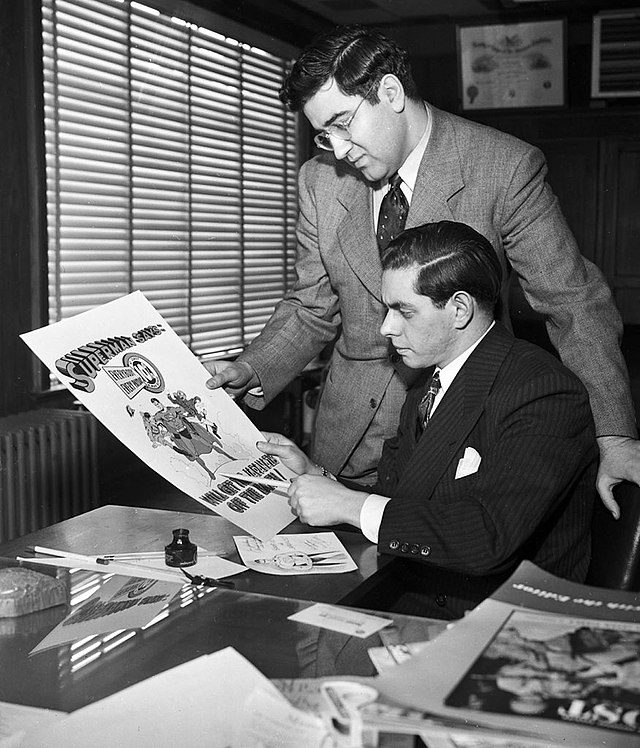
Some far-right extremists say comics are part of a Jewish media conspiracy. Perhaps I could make a comic that takes this into account. How do I take that into account? First I need to visualize the problem. So I look at a picture of Jewish people creating Superman. 

I see what the far right in Germany thought about this photo. Joe Schuster is pointing his pen at Superman. He is selling out the Nazi ideal image, forming a media presence, and helping form a positive impression about Jewish people worldwide.

The Nazis become angrier about Joe Schuster making money from his pet project, than about the comic itself. They are upset that he is storing gold in the basement of a house in America, where Hitler will be kept out of the reading room, and Jewish children will live in union with God.  This was very upsetting to militant Nazis in Germany, apparently, if history is to be trusted.

All this because the Jewish genetic makeup is, according to unscientific diagrams, supposedly of deformity and mental illness and disease. And Superman proves this somehow, too well, to the Nazi mindset about comics and degenerate art and their ideal of freedom from Jews.

How does Superman prove Jewish mental illness to the Nazis? Somehow Superman stands for the Nazi freedom ideal in reverse of itself. It is the inverse image of the Superman that the German Nazis believed in, which was promulgated by their propaganda about Friedrich Nietzsche. 

The Nazis are battling themselves on many fronts. They are battling the inevitability of progress in any genetic makeup of those with mental illnesses, and they are battling the progress of the Jewish people. They are battling the entire Jewish extermination program also, because this program exceeds the boundaries of extremism, by quite a large degree. It is counter productive to kill the enemy based on ideals of fitness, because there is no absolute standard for human perfection. 

Humans are all imperfect. We all might as well have mental illnesses, and be Jewish. It doesn't matter. Perfection is not the point. Genetic goals are not the point. The ideal is fulfillment of our genetic makeup, in the mode of living, not the extermination of others who don't stack up to the genetic ideal of the moment. 

Jerry Siegel and Joe Schuster were living that ideal, of personal fulfillment, and community activism and involvement. They were fulfilling their innate human potential, and the Nazis were trying to proclaim themselves the Superman. All this while two Jewish men made comics about it. In the end I suppose it makes all the difference in the world that these two added something more to our understanding of others in the world, rather than detract from it. Giving back instead of taking away human dignity and freedom, not to mention human lives, was a setback for Germany and the world.

Let's move forward and learn from these mistakes, never forgetting these lessons, because our children and our future generations will need to understand.

Wednesday, March 1, 2023

Ready for Work on Comics

I'm old and have no hair, which is all the better reason to get going and really work on my best work, in my twilight years. Age is my asset, as I have tons of experience and style. My body type is not the real reason for assuming I'm not fit for work, is it? Body type does not disqualify people from work opportunities, if the person is physically and mentally capable, which I am according to my doctor. Cease and desist your apathy, and do some more work on what you feel you want to. Work is not a crime at any age.

  1. Ableism (also, The Con Artist's Fallacy; The Dacoit's Fallacy; Shearing the Sheeple; Profiteering; "Vulture Capitalism," "Wealth is disease, and I am the cure."): A corrupt argument from ethos, arguing that because someone is intellectually slower, physically or emotionally less capable, less ambitious, less aggressive, older or less healthy (or simply more trusting or less lucky) than others, s/he "naturally" deserves less in life and may be freely victimized by those who are luckier, quicker, younger, stronger, healthier, greedier, more powerful, less moral or more gifted (or who simply have more immediate felt need for money, often involving some form of addiction). This fallacy is a "softer" argumentum ad baculum. When challenged, those who practice this fallacy seem to most often shrug their shoulders and mumble "Life is ruff and you gotta be tuff [sic]," "You gotta do what you gotta do to get ahead in this world," "It's no skin off my nose," "That's free enterprise," "That's the way life is!" or similar.